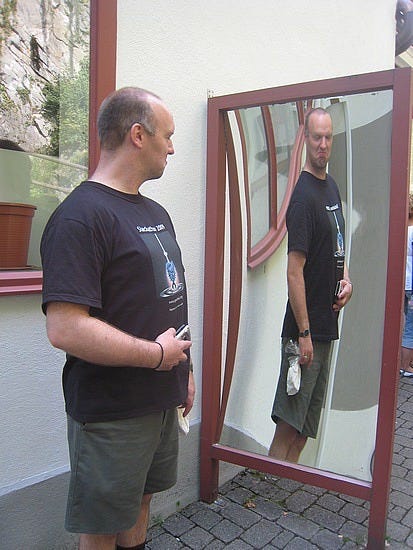
To me, it’s been known that Atheism, Skepticism and Theism have varying perspectives on the meaning of reality (mainly 3) based on their identity and existence of God.
Here, in this post, I’d like to share with you, my view of what it means to have these varying perspectives using Analogy of Mirror, and why it’s important.
What we already know:
It’s well known that perspective changes based on the angle we look at the world. For example, if you take a photo of yourself from below, you’ll see a tall body with long legs. If you take a photo of yourself from top, you’ll see mostly head and upper body, etc.
This analogy is consistent with the idea that one reality can be seen from multiple angles and gives us different view on life.
What I want to share:
Now imagine you are standing in front of room of mirrors. Each mirror reflects what you and your surrounding exists. But let’s say that each mirror is not like one another, and by that I mean that one mirror makes you look thinner, the other makes you look fatter, the other has oval effect, etc.
So depending which curvature exists in the mirror, your reflection will be different. This is called difference in perspective via curvature of mirror. Concave mirror Mirror that makes you look thin
Note that it is utterly possible for us to see near perfectly straight mirror, and still see small or big distortions in reflections. It is due to the idea that small dents might persist here and there in varying places on the mirror.
My argument:
If we could have a perfectly straight mirror, then whatever light we input into the mirror - such as data, information, food or energy, or idea - would come out straight and direct, making the output - such as interpretation, analysis, work, etc - resembling perfection. However, since every person has slightly differing perspective on life, it would explain that every person has slightly different mirror inside them. By different mirror, I mean, a mirror with different curvatures in places. For example, I might have straight reflection in one of these places - top, middle, bottom, one of corners - giving me edge in data processing at chosen location. However, someone else might have better reflection at other parts of their mirror. Thus checking how one’s mirror looks like would help us to process data better. Not only that, we can optimize each other’s mirror by learning about the reason of emergence of curvatures or lack of. I personally think this is a whole topic or field open to study.
My second argument:
Atheism believes that God is different from what Skeptics or Theists believe about God. For example, Theists believe that God is all knowing, possibly perfect and possibly all understanding in correct perspective.
It would mean that if a perfectly straight mirror is perfection, then Theists believe that God would have this kind of mirror.
But Skeptics believe that God might be a clockwork, a being that’s not so sympathetic with humans, thus have differing perspective on life from humans. Hence our mirror (and its curvature) might present differently to God’s mirror.
Whereas Atheists believe that God is totally detached from human life, doesn’t care about humans and even don’t exist or so much so that don’t exist. This is synonymous with the perspective that God is disinterested in human way of thinking, so that our mirrors are absolutely different.
In conclusion:
Analysis of Mirror was used to unify Atheism view, Skepticism view and Theism view to find common ground for understanding. This idea is novel, so it’s open for discussion and rigorous stress testing. However, I should note, it’s important to value one’s self, even in midst of culture shock. This theory only implies that God can be loving and rewarding those who want to and can improve their inner mirror. My theory doesn’t mean to cause chaos or disillusionment. It’s important to keep believing that self-improvement and self-development is valuable and important for us all. Thank you
Thank you for reading. Do you believe this Analogy of Mirror has helped you unifying the perspective of Atheism, Skepticism and Theism in one place?
I’m not sure I follow your OP, but I generally find abstract theories hard to make sense of.
Atheism is defined in various ways, and there are clearly old institutional definitions as well as varying usages of the term. For me, as an atheist, it simply means I am unable to believe in a God or gods. I try to make no specific truth claims or any other inferences from this.
I tend to think of atheism and theism as operating something like a sexual preference. You can’t help what you are attracted to. Reasoning is likely post hoc. Adding a god to my meaning making process doesn’t really help me in any way, but it helps others.
I see comments that talk about disatisfaction, so I think this means that there are missing links or weak argumeng or weak evidence to support my claims.
In the next hour or so, I will revise to make it better. Thank you for your attention. And thank you for taking moderation when criticizing
I understand your point of view. Indeed, it’s possible to consider belief in God as someone’s preference. That’s because of several underlying premises.
Premise 1:
Humans have free will or some kind of autonomy.
Premise 2:
Humans have different attraction toward God.
Premise 3:
Humans believe that if God was real, then there would be some human-like relationship.
All these premises combined, it might seem like believing in God could be resembling a sexual attraction - attracted or not. Moreover, every person has varying sexuality, and maybe attracted towards God for differing reasons, or fetishes (in the case of sexual attraction).
Cool. I guess belief in God (I’m going to stay away from the word “faith” at this point, as that introduces a different nuance for me) can arise in various ways.
Some people inherit an unquestioned belief from their culture and upbringing; it is simply the wallpaper of their life. Others may arrive at belief through what might be considered nominal or even poor reasoning. Others, however, may undertake a careful and scrupulous evaluation of the arguments and arrive at belief based on some disciplined and considered process.
Are these premises or underlying reasons?
I think what we really need to include is the role of socialisation and enculturation in shaping belief. While there are converts to other religions, most theists inherit their beliefs through the social and cultural contexts into which they are born, rather than reasoning their way independently into theism. Belief in God is community as much as it is an affirmation of transcendence.
But if your mirror analogy is simply saying that belief depends on how you look at things, the perspective you bring to them, is this sufficiently nuanced to be a significant insight? Could we not apply exactly the same process to politics, or even to the kinds of movies we like?
I was once an atheist and once a theist. Right now, I hold both views and stress test when I have free time.
These are premises. (Check definition of premises in Google.) They are premises because they are only real to us because we assume that they are real. They key word being, “assume”.
To explain, why they are only premises and not “reasons”, because you can’t prove that free will or some kind of autonomy exists within us. Free will or some kind of autonomy is intangible (meaning it’s in the air or within other plane of space, while attached to our identity) and hard to prove. But it’s a cornerstone (building block) of our society at large, so we believe that they exist in modern times. We started believing that because we needed some reason or premise to establish punishment and reward for individual’s actions.
Most people would argue that this cannot be done. It is a contradiction. If you are saying both that God exists and that God does not exist, it might be said that you are either holding a form of negative theology or are simply confused.
Not sure I follow.
Are you just saying that theism has a useful function therefore is “true” even if there is no god?
I suspect there are some underlying assumptions that have led you to this. These might be more illuminating than the theism question. I’m thinking here about meaning and morality, which you seem to be alluding to in all of this. Did you grow up on a strongly Christian family?
When taking data and converting it into information, it’s important to do it with straight mirror. It’s synonymous with the idea of preferring to use isolated vacuum chamber to test, the fall of feather and iron ball. If air particles were to exist between the falling objects, then the impurities (such as curvature in the mirror) would set incomplete data and result in incomplete information.
From my personal view, politicians are humans too and are also capable of making mistake of curved mirror. I’m not gonna debate that here or the extent someone is curved, because that is up to study.
You need to provide me with countering examples and arguments. Because you aren’t stress-testing anything right now. All you are asking me, is asking for definitions of words, which you could do by Googling.
Can you make longer argument as to why you believe this cannot be done?
I can’t provide a counterargument to a position that remains unintelligible to me; before critique is possible, there must first be some shared understanding of what is being asserted.
I’d prefer this not to become hostile so I will leave this for now. Take care.
The statements “God exists” and “God does not exist” are direct negations of each other. Most philosophers would argue that under the principle of non-contradiction, they cannot both be true in the same sense, at the same time, and under the same conditions.
I see your point now. I’ll explain my point.
Theism is a belief, because Theism cannot be proved.
Atheism is also a belief, because Atheism cannot be proved.
At first I was a Theist, someone who believes in God.
But then I dropped Theism and adopted Atheism. Is that clear?
Then I dropped Atheism, and adopted Theism again.
And so on, till I find something more rational.
I change my belief based on evidence I find,
rather than be stuck with belief and reject new or real evidence.
Can you quote where I have referred to my own experience? And did I use my personal experience (as evidence) to support my claims? Because I can’t see where I did so
You did not reconcile the apparent contradiction. You merely explained that you have changed your mind more than once.
Are you, perhaps, trying to convey that your position is dependent on which perspective you apply, and that both are equally plausible? If so, this seems more consistent with agnosticism.
Your statement about atheism is not consistent with my view, as an atheist. I simply don’t believe an intentional being (or beings) exists that created the natural world. That’s a denial of every form of monotheism (including deism) and polytheism.