When people colloquially say, “perspectives differ” they mostly mean angle or position. So I wanted to add one more layer to that meaning of perspective, curvature.
Here, in this post, I’d like to share with you, my visual understanding of what it means “Kant and Cognitive bias research” using Analogy of Mirror, and why it’s important.
-
What we already know:
It’s well known that perspective changes based on the angle and position that we look at the world.
For example, if you take a photo of yourself from below, you’ll see a tall body with long legs. If you take a photo of yourself from top, you’ll see mostly head and upper body, etc. Also if you place the camera close to you, the final shot will look different from further shot.
This analogy is consistent with the idea that one reality can be seen from multiple angles and positions and gives us different view on life. -
What we know about Kant and Cognitive bias research:
Kant argued that we hold some kind of mechanism with which we process the outside reality. And this mechanism which we call intuition and cognition, resembles a mirror, through which reality enters and reflects. When reality enters us through sensory organs, we process through our intuition, which I will represent as light striking the mirror. Then depending on the distance, angle and curvature (or lack of), we use cognition to reflect the reality, and we project our understanding of reality to other people or objects. The result of projection may or may not always match. So imagine that you are a mirror, and light is what comes and goes to reality.
As a result, my hypothesis is that reality might either match or partially match the actual reality, depending on the angle and position of the mirror but also on the curvature of the mirror itself. -
Kant’s 4 classes:
The reflection works to see the world in 4 classes, as Kant stated: Quantity, Quality, Relation and Modality. When light shines onto the mirror (person), the reflection will show quantity, quality of the objects nearby, as well as relation, such as how some objects are next to each other. As for modality, color of light entering the mirror might be different.
Kant’s modality possibility in this mirror analysis means that mirror is capable of receiving cosmic light but is incapable of seeing light as it is, due to it being beyond visible spectrum. Hence, due to the narrowness of visibility, limitations such as sense of violation of the laws or pure limited understanding, we might feel the light is impossible to be reflected.
Kant’s modality actuality in this mirror could mean that we reflect light that’s in visible spectrum.
Visible spectrum of light
Kant’s modality necessary could mean that mirror reflects light at certain angles bounded by physical laws.
Reflection of light
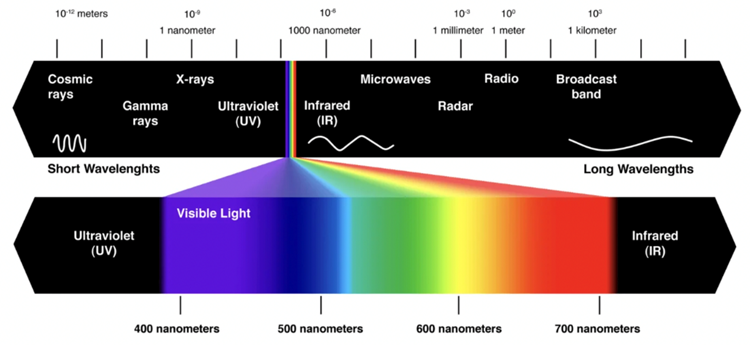
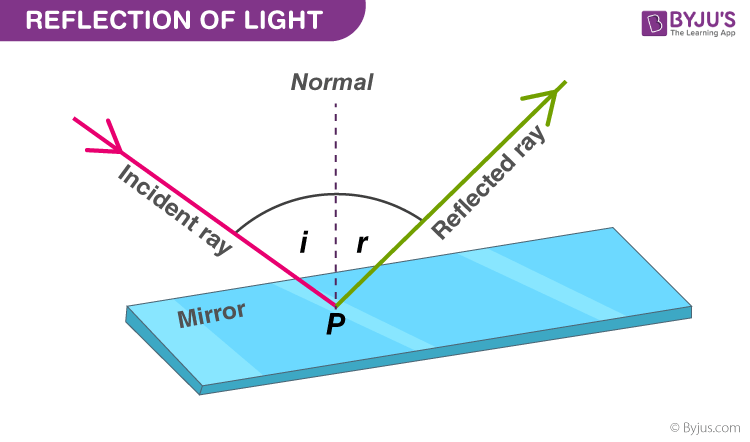
As a result person (mirror) might not imagine yet, then believe yet or agree yet that some light (data, information, reality) exists, until it receives something in terms of that color wave or broadly speaking different spectrum of visible light, or even more broadly speaking, other spectrums of light that’s not visible but true in existence to be understood and reflected.
I find interesting that color as visible spectrum of light can explain other thing as well. People have mood or beliefs, which affect how they reflect on reality. Instead of mood or beliefs, we can have mirrors with shaded colors in them. Also depending on the color of mirror (or lack of) the light bouncing out can be of different color as well. I attribute color to the mood or inner comfort or emotional distress or their beliefs even, one feels, however, color itself might not be a bad thing. Moreover, some mirrors might be prone to absorbing certain spectrum of colors more than other colors, so that they help others to remain cool or more combustible, is my hypothesis. Also color and curvature are independent variables.
- How would this visualization work in real life?
Now imagine you are standing in front of room of mirrors (persons). Each mirror reflects what you (a mirror) and your surrounding exists. But let’s say that each mirror is not like one another, and by that I mean that one mirror makes you look thinner, the other makes you look fatter, the other has oval effect, etc.
Mirror that makes you look thin
So depending which curvature exists in the mirror, your reflection will be different. This is synonymous with Kant’s idea that our mechanisms of understanding, such as intuition and cognition, are subjective.
3 differently curved mirrors
Uniformly curved mirror, but not straight mirror
I’m not arguing that a perfect mirror has to be perfectly straight. It could be curved in multiple plains much how different geometries exist. And this is not limited to possible plains in multiple dimensions.
Whether certain mirror is best or good or efficient or logical or universally logical, is up to study.
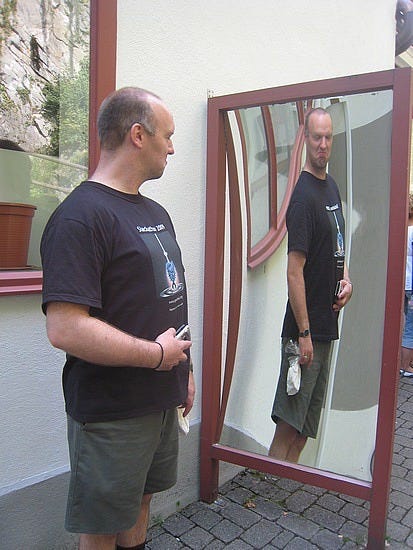
Though I want to point out the idea that
5. Mirror can reflect another mirror.
Mirror analysis is also interesting because it can help us visualize what it means to have metacognitive awareness. When mirror (person) looks into another mirror (person), it can check and see whether something is odd or different or new or better, etc.
We can start off with what I believe a mirror in human can do for humans in general. The mirror can see another mirror. The mirror can remain solid when necessary. The mirror can curve or bend depending on the pressure around (evidences given), so that mirror can evolve to some new form to adapt to survivability as well as to seek objective truth in quantities and qualities that we can find within limited power such as time, energy, space, support for talented people, etc. The major importance of mirror is to help us understand the world around us and be free from making mistakes such as logical or structural errors, and thus adhere to not harming people around us, while thriving as individual or society as a whole.