Entropy: Phenomenon or Idea?

Entropy is an intriguing scientific notion. It is mostly associated with randomness, uncertainty, and disorder. Particularly, inside the field of thermodynamics, it constitutes a fundamental law, which states that:

The entropy of an isolated system left to spontaneous evolution cannot decrease with time. As a result, isolated systems evolve toward thermodynamic equilibrium, where the entropy is highest. “High” entropy means that energy is more disordered or dispersed, while “low” entropy means that energy is more ordered or concentrated.
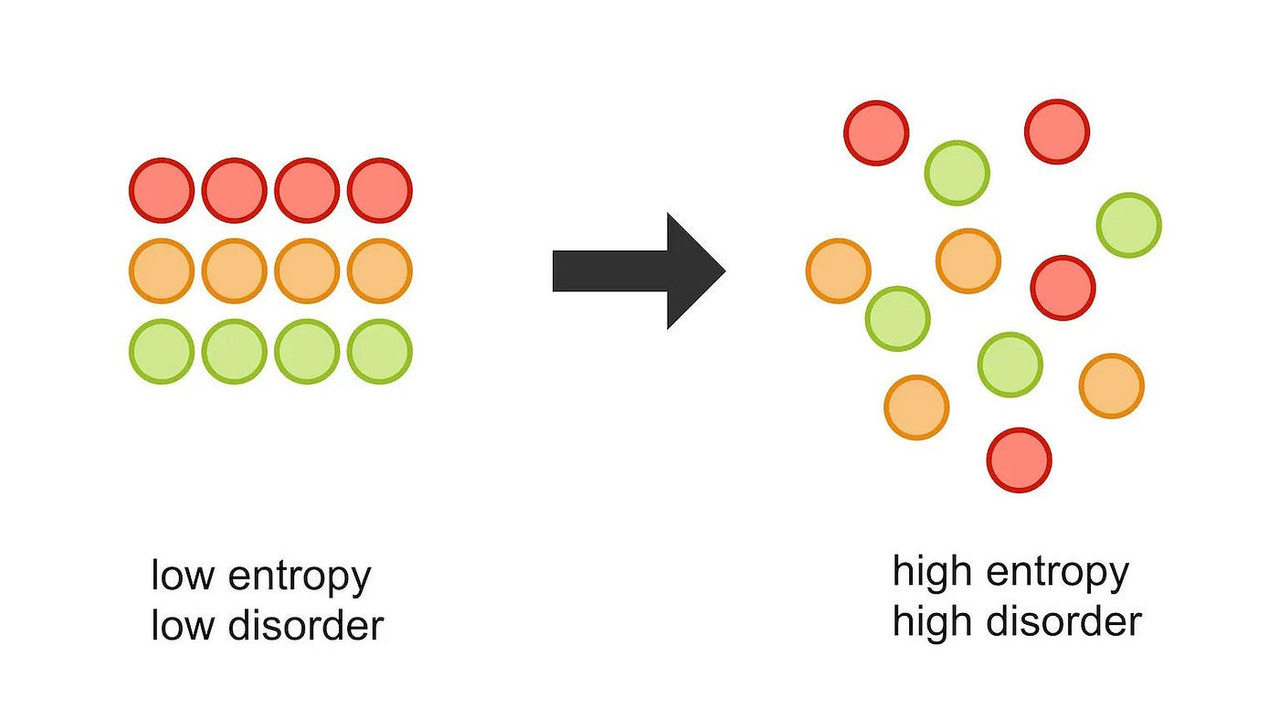
Basically, thermodynamics explains that entropy is essential and disorder is needed for creation and adaptation. This process constitutes a phenomenon inside the field of physics.

First question: From a phenomenological perspective, do you think entropy is inevitable and we are forced to move towards chaos and disorder?


On the other hand, Entropy has philosophical implications. These are my thoughts:

Entropy appears perhaps inevitable, yet we humans tend to live in structured civilizations with ordered laws. Thus, that is what constitutes a society. The society is order. So, the way we live in appears to be an act of default against entropy. Therefore, we are compelled to “waste” energy to maintain social structures, such as infrastructure, governance, and community services, which are essential for the functioning of society. It seems we are inevitably led to do this because the act of civilization is one of the oldest signs of our existence.

However, there are other philosophical perspectives on this, and according to Stoicism and Buddhism, entropy seems to be a physical reminder of the transience of things. Not everything remains forever…

Second question. From a philosophical perspective, are we inevitably led to transformation by entropy, or do we tend to align with the purpose of avoiding it?


Bonus question: Is entropy a phenomenon or an idea?

Thanks.

1 Like

More precisely, the second principle of thermodynamics applies to isolated systems and states that the spontaneous evolution of an isolated system is towards a higher degree of entropy.

To make an example. Consider an isolated box which is divided in two non-communicating parts. In one of them, you have two identical particles that move randomly. If you remove the barrier, after a sufficiently long time you expect to find one particle in each part of the box. It is the most likely configuration. So, really, the Second Principle of Thermodynamica really says that spontaneously each isolated system tends to evolve in the most likely way.

Given that the universe seems to be an isolated system*, it does seem that the entropy of the universe will always increase. The efforts of living beings to ‘steer’ the events in a favourable way seems to be hopeless in the long term.

At the same time, however, despite this, it is undeniable to me that the appearancw of ‘life’ and ‘consciousness’ were potential outcomes of the evolution of the universe, which seems to me an incredible paradox for such a universe which seems to spontaneously evolve to states that are incompatible for life. This ‘paradox’ causes into me a sense of wonder and amazement to be honest.

But yeah, unless the scientific understanding of entropy will be shown to be incomplete, the current scientific understanding does suggest that the universe is to be poised to eventually become lifeless.

*There is some debate among physicists about the fact that perhaps the expansion of the universe implies that the universe cannot be considered an isolated system.

I really like this example.

But allow me to ask some questions. My aim is not to contradict you but to keep learning:

Of course I expect that one of the particles will move to each part of the box if you remove the barrier of the box because entropy shows us that the phenomenon tends to disorder. But why does this happen? Is it just inevitable? Is it a basic principle similar to the fact that if we don’t breathe, we die?

It is crazy to see that we can find evolution in disorder. Yet we tend to find solutions to avoid disorder in some areas. Why do we do this?

It is hopeless to us, but not for some isolated systems like the universe. This makes me wonder whether our existence is due to randomness or simply a response to entropy.

Exactly. I agree.

In 1947, in a Stalinist labor camp, a physicist named Pobisk Kuznetsov organized a philosophical discussion group among prisoners. Their question: what is the function of life on the scale of the universe?

@boundless has just described the paradox they were wrestling with. The second law says isolated systems tend toward maximum entropy — toward the most probable, most disordered configuration. The universe appears to be such a system. Yet here we are — highly organized, highly improbable. Life builds structure from disorder. Consciousness builds understanding from structure. How?

Kuznetsov’s answer: life is anti-entropy. Not as metaphor — as measurable physical function. Every organism imports energy, exports disorder, and locally reverses the entropic current. A plant, a bacterium, a brain — each creates order that would not spontaneously arise. Life does not violate thermodynamics. It uses thermodynamics against itself.

But this only pushes the paradox back. If entropy wins in the long run — if heat death is the final destination — then life’s anti-entropic work is a temporary eddy in a one-way current. @Javi asks whether our existence is randomness or a response to entropy. But both options accept that entropy has the last word.

Kuznetsov’s friend — the philosopher Ewald Ilyenkov — refused to accept this. In an unpublished treatise from the 1950s called “Cosmology of the Spirit,” he asked: if entropy always increases, and time is sufficient, why is the universe not already dead?

Something must be resetting the clock.

Ilyenkov’s answer: thinking matter. Not life in general — plants create local order but cannot act cosmologically. Only thinking — the highest form of matter’s self-organization — can harness enough energy and understanding to counteract entropy on a universal scale. A civilization at the peak of its development would face the dying universe and do what must be done: deliberately trigger a new cosmological cycle, at the cost of its own annihilation.

This changes the question. Entropy is not just a phenomenon we observe or an idea we construct. It is the condition that makes thinking necessary. Without thinking matter, the universe dies permanently. A universe that requires thinking to continue existing is a universe in which consciousness is not accidental but structurally essential.

So when @Javi asks “Is entropy a phenomenon or an idea?” — perhaps the deeper question is: is entropy the reason why the universe had to produce minds?

1 Like

Yes, it’s crazy.

Regarding to the first questions, I think that it is because the vast majority of our universe is ‘made of’ inanimate ‘entities’ and the increase of entropy is just what we expect if this is true.

At the same time, however, isn’t it weird that living and conscious beings came into existence in the first place if, indeed, the ‘increase on entropy’ is the most fundamental truth of this universe?

I mean I agree that the second law of thermodynamics is compatible with our existence but, neverthless, it is rather amazing that a potential outcome of the story of the universe was the arising of life and mind.

I mean, if you consider the second principle of thermodynamics as truly describing the most complete and deepest truth, it is rather weird that the universe allowed life and consciousness in the first place.

1 Like

A very well-written post and thoughtful ideas.

It seems to be. At least, this is the conclusion that I arrived at with the exchange I had with Boundless. The problem with understanding entropy (at least for me) is that it is divided by two different perspectives: phenomenology and philosophy (metaphysics, perhaps). The first concludes that entropy inevitably leads to disorder because it is essential to isolated systems. But the second, I think, asks why this actually happens in the first place. Notice that if entropy were truly infallible, we would never have been born, because we are clearly the antithesis of that.

Something that I still can’t see is why it is said that we waste a lot of “energy” on avoiding entropy. If it will not be worthy in the long run, we should stop and start accepting the consequences. Furthermore, this reminds me of free will in some sense. We lack free will and are predetermined because, according to entropy, the universe is destined to become lifeless, making our existence a mysterious surprise.

Does this mean that the universe dies repeatedly?

But that point is a construct, an idea; it is not a phenomenon. Do you agree?

Yes, very well said. It is rare that our existence has occurred. Perhaps our existence is merely an accident.

The role of our lives and consciousness in all of this remains confusing. What if the universe’s allowing us to exist is evidence that it wants to confront entropy?

1 Like

Even if it was an ‘accident’, one can still say that it was a potential outcome. In an universe that seems so ‘hostile’ to life (let alone consciousness and reason), why did we come into existence? How can our existence be fitting in such a universe?

Maybe… but this would imply to say that there is an innate ‘purposefulness’ in the cosmos, which is a radical departure from the usual ‘physicalist’ picture.
I’m not saying that this is wrong and I have a sympathy for it but if our existence ‘foresees’ a ‘role’ for life and consciousness, why is it so rare?

Honestly, I believe that, no matter the ‘worldview’ one takes, this world is quite mysterious.

Phenomenologically, there is no entropy since we’re not a closed system. Energy comes in and out at a pretty steady pace and forms a phenomenological balance. Of course the entropy has to go one elsewhere, such as the sun losing tons of mass per second. Dreadfully inefficient.

So, the way we live in appears to be an act of default against entropy.

Just so. Energy in from the outside, and thus entropic stability.

Not everything remains forever…

Of course not. Earth has already used up over 80% of its time, after which multicellular life can no longer be supported. Several billion years after that, even the existence of Earth will cease.

Surely there’s more options than just those. I would suggest that we tend to leverage entropy in order to align with other purposes.

That’s the second question. The one preceding that one should be something more like “does life serve a function on the scale of the universe?”. If yes, then you can move on, and if you run into problems (as your post shows he very much does), maybe the ‘yes’ wasn’t the right answer. I think it does serve a function. It makes the universe exist relative to a semi-rational observer. But that’s also using a pretty relational mind-dependent definition of ‘exists’. “It exists to them what observes it”.

Life builds structure from disorder.

So do stars, and gravity in general. This isn’t particularly a property specific to life.

Kuznetsov’s answer: life is anti-entropy. Not as metaphor — as measurable physical function.

Sure, but that just means that life cannot be a closed system, else it would violate thermodynamic law. Thermodynamics is embraced.

In an unpublished treatise from the 1950s called “Cosmology of the Spirit,” he asked: if entropy always increases, and time is sufficient, why is the universe not already dead?

Something must be resetting the clock.

This presumes there is a clock to reset, that the universe exists in time. Back in the 50’s, the implications of Einstein hadn’t really penetrated to most. So this problem is his to resolve. My universe has no age. Life goes on in the parts of a comfortable distance from the lower boundary. The universe does not meaningfully have a ‘current age’ or a clock driving it.

1 Like

There is no “forcing,” it’s just a matter of probability. When the universe moves from one state to another, those changes will tend to be in the direction of more probable outcomes. There are always fewer organized outcomes than “chaotic” ones.

Entropy used in this context is metaphorical. Nothing wrong with that, but looking for too close a connection can be misleading. Taking up your metaphor, discussions of entropy always apply to closed systems. Entropy can be countered by adding energy from outside the system. That is true of physical systems and can also be true, metaphorically, of social systems.

Both.

All phenomena are also ideas.

Entropy is just an idea, better called an “ideal”. There is no such thing as an isolated system, that’s an impossible ideal. In general, the second law of thermodynamics just indicates that the passing of time is something real, having a real effect on the physical world. Since neither engineers nor scientists understand the real passing of time, they use an ideal to represent it, the second law of thermodynamics.

1 Like

This is good. I like Brian Green’s explanation of entropy in Until the End of Time. Shake a bag of a hundred pennies, and dump them on the table. The odds of getting 50 heads and 50 tails are about a hundred billion billion billion times more likely than getting all heads.

As the air molecules move around a room, it’s incalculably more likely that they will be fairly evenly spread throughout the room than that they’ll all be bunched in one corner, leaving us to suffocate on the other side of three room.

1 Like

@noAxioms @T_Clark @Meta_U @Patterner

Thank you so much for your insightful contributions and ideas. I’m a bit busy right now, and I can’t answer to each of you individually. Furthermore, I would like to increase my knowledge on entropy and try to come up with worthy ideas. I will respond as soon as I’m ready.

1 Like

@Javi

Three questions — let me take them one at a time.

Does the universe die repeatedly? On Ilyenkov’s account, yes. Not as mysticism but as a consequence of the argument. If entropy always increases, and the universe has existed long enough that it should already be dead, then something must be resetting the cycle. Thinking matter — having reached the peak of its capacity to organize energy — triggers a new cosmological beginning. The universe is reborn. Eventually, under new conditions, it produces life and thinking again. A cycle, not a one-way road.

This is speculative. Ilyenkov knew it was speculative. But it follows logically from two premises that are not speculative: entropy is real, and the universe is not dead. Something is counteracting entropy on a scale we do not yet understand.

Is the claim that thinking is structurally necessary a construct or a phenomenon? It is a hypothesis — derived from observable phenomena (life as measurable anti-entropy, thinking as its most organized form) but not itself directly observed. Its consequences, however, are testable: does thinking actually counteract entropy on increasing scales? So far — agriculture, engineering, medicine, spaceflight — the answer is yes. Whether it can do so on a cosmological scale is the open question.

The connection to free will. You write: if the universe is destined to become lifeless, our existence is a mysterious surprise. But Ilyenkov’s point is exactly the reverse — our existence is not surprising at all, because the universe cannot become permanently lifeless. It needs us. Not in the sentimental sense. In the structural sense.

@boundless

You raise the key objection: does this imply purposefulness in the cosmos?

It implies necessity, not purpose. The difference matters. Stars do not intend to fuse hydrogen — but given sufficient mass, fusion is structurally guaranteed. Nobody designs it. The structure demands it. Similarly: the universe does not want to produce thinking. But if anti-entropy is a real tendency of matter — not just a local accident but a structural feature — then thinking arises not because someone planned it, but because the conditions for it are built into the way substance works.

Purpose requires an agent with intentions. Necessity requires only structure. Spinoza made this distinction three centuries ago: God (or Nature) does not act for the sake of anything. It acts from the necessity of its own nature. Thinking arises the same way — not for a purpose, but from necessity.

You ask: if consciousness has a role, why is it so rare? Because anti-entropy requires increasingly demanding conditions. Single-celled life is abundant — its organizational demands are low. Multicellular organisms are less common. Thinking requires not only biological complexity but social complexity — language, culture, tools, accumulated knowledge. Rarity is not evidence against necessity. It is evidence of how difficult the conditions are to achieve. Diamonds are rare. They are not accidental.

However, the kind of order that life has is quite different from the order that a star has. Each living being behaves as a single whole, has its metabolism, reacts to the environment and so on and acts in a way that seeks to self-pereptuate. A star is more like a hurricane or whirlwind, i.e. a relatively stable patter.

Out of curiosity, what’s your take on the expansion of the universe? Does it imply that the universe isn’t an isolated system? If so, the second law of thermodynamics wouldn’t really apply to the ‘whole universe’.

Yes, that’s a possibility. But notice that this isn’t the common ‘physicalist’ view. The kind of universe you’re describing is certainly not a reductionistic one.

Oddly enough, I believe that ‘classical theism’ isn’t really far from what Spinoza says here, except it also takes God as Personal. After all, in ‘classical theism’, God is ‘beyond time’, immutable, omniscient and so on and, therefore, God can’t aim to something as we do.

Sure. But at the same time you need to ask: why are these conditions so difficult to achieve? I don’t think that such a question needs to be answered. But I find it still curious.

There’s an intriguing convergence between Evald Ilyenkov and Nikolai Berdyaev despite their very different vocabularies. Ilyenkov speaks in the idiom of Marxism about “thinking matter,” while Berdyaev speaks openly of spirit and freedom, yet both end up assigning a cosmically significant role to consciousness. In each case, thought (or consciousness) is not a passive byproduct or ‘emergent phenomena’ but an active, world-shaping principle—something through which reality comes to expression or even completion. The difference is largely one of language and framework: where Berdyaev names it directly as spirit, Ilyenkov approaches a similar idea from within a materialist register, stretching it toward something that begins to look remarkably like a philosophy of spirit in Marxist guise (and hence, I learn, Ilyenkov was at one point censured for being ‘too Hegelian’.)

No argument there. I was just noting that the stated attributes of life forms were not unique to life forms.

I have no idea how expansion is relevant to that question. A lot depends on one’s definition of universe. The observable universe is not closed, so energy/mass and whatnot tends to enter the system from the outside.

The classical universe (all of spacetime and its contents) is closed by definition, but being infinite in size, it has no ‘total mass/entropy/whatever’.
Expansion seems not to play a role in any of that.

No, I don’t believe so. Entropy is a result of natural processes without human intervention. But used in this context, metaphorically speaking, we do have the agency to protect the integrity of our population. So, it is not inevitable that we will suffer entropy.

There is growth and decay, yes; but I don’t consider it as a negative. It is a fact of the universe.

1 Like

Ultimately, I don’t know how ultimate entropy, and the death of everything, could be avoided. Even if it’s trillions of years away. Everything is expanding, moving away from everything else. Stars form, but go supernova, scattering everything even further apart. If life is too continue, it will need to go farther and farther to gather resources. Of course, it takes more resources to go father for resources…