Adornian Ahistoricity via Zorba the Greek

The following is an attempt to explore Adorno’s idea of ahistoricity through the lens of the novel Zorba the Greek. Neither a deep knowledge of Adorno nor familiarity with the novel should be necessary in understanding the main point.

What is Zorba the Greek about?

Zorba the Greek by Nikos Kazantzakis, written in 1946, concerns the relationship between a sheltered young bookworm (the narrator) and a wild older man called Zorba. The novel stages Nietzsche’s conflict between the Apollonian and Dionsyan, the rational/intellectual and the romantic/natural. The narrator exists in the world of concepts to which he appeals for guidance. Zorba, by contrast, is guided by whim, intuition, and drive.

So, we’re presented with the age-old thought vs flesh divide. And Kazantzakis effectively shows that the appeal to reason can result in a narcissistic reduction of everything to a symbolic world whose only purpose is to provide relief to the one trapped in it.

This is where Kazantzakis succeeds. He shows that neither the narrator nor Zorba has the “answer”. The narrator uses concepts to keep life at a distance, views it as a kind of purely external drama to be interrogated, the purpose of which is his personal edification and enlightenment (literally, in fact, through his fascination with the Buddha). Zorba, for his part, views life as something he is continuous with and ought not interrogate from a distance, thereby absolving himself of true responsibility for his actions. Zorba’s self-proclaimed singular responsibility is to be Zorba. And his rhetorical questioning of the narrator about life is merely a means to entrench his own view that God and the Devil are the same, and that, whatever he does, he’s right in that he serves one or both in serving himself.

But I want to examine here where I believe Kazantzakis fails, and to use Adorno’s idea of ahistoricity as the theoretical lens in so doing. I’ll first introduce Adorno’s criticism of ahistoricity from negative dialectics (via a brief introduction of the project of that book) and then try to show how the novel, specifically by falling into the type of trap Adorno describes, enacts the type of ideological functionalization that Adorno’s negative dialectics aims to be a corrective to.

Negative Dialectics

Adorno’s project in negative dialectics is to combat a reductive identity thinking whereby the concept is taken to fully represent or exhaust its object. He wants us to recognize the limits of philosophy in order to expand them. That is, we get closer to the object by respecting its non-identity with conceptual thought.

This helps explain why he employs the term “dialectic”. He recognizes a tug of war between the attempt to establish meaning through language (conceptualization) and what resists the establishment of meaning through language (the object to which conceptualization is applied). But the dialectic does not resolve itself in this tug of war into full understanding; rather, it shows that to presume full understanding means to come down on one side, i.e. conceptualization. But this is to falsely eliminate a necessary tension between concept and object. That is, ro fail to do justice to the negative result of dialectical thinking, which insists that there is no resolution. There is always an excess that is missed. The concept can never become the object, only approach it.

Ahistoricity

Adorno then wants to grant the objects of conceptualisation their full complexity and ultimate inaccessibility, so he sets out to oppose the kind of reductive philosophy, in whatever form such thinking presents itself, that denies them this..

Ahistoricity is one form of this denial. That is, imagining concepts to be ideologically neutral rather than inscribed by the progression of the social forces through which they have become legible to interrogation in the first place. Moreover, since this interrogation inevitably involves a mediation of the thinking subject and its object, and the subject is always suborned to a large degree by the social context in which it itself developed, there is no pure ideological space in which objects can reveal themselves to subjects.

Of course, philosophy would like to posit such a space because it seeks knowledge to the limit of fullness. And Adorno, in combating this tendency, takes aim, for example, at Husserl’s phenomenological reduction, which tries to establish a purified immediacy in its “bracketing” process. To Adorno, this is an impossible goal—there is no neutral bracketing that can reveal a pure object of conceptualization. Rather, the attempt does violence to the concept by denying it an irreducible mode of its being, its historicity.

No doubt this can be considered arguable, but instead of attempting to further justify Adorno’s conclusion, I’ll move on to analyse how Zorba the Greek performatively exhibits this violence—more specifically, how its structural failure exposes a problem the text cannot deal with on its own terms due to that failure.

The Treatment of Women in Zorba the Greek

What initially alerted me to this problematic in Zorba the Greek is the treatment of women. Women are universally passive in the novel, objects of fascination, lust, and violence. It’s not simply that the two main characters, the narrator and Zorba, treat women like chattels, even debating whether they are human or not, but women are given no agency of their own in the book to question these terms. Zorba and the narrator dramatize the primary conceptual conflict. The female figures symbolize sub-concepts that these primary figures consume and refigure in order to try to properly subjectivize themselves. The narrator, in particular, constantly tries to find himself through processing ideas. Women become reduced to objects that are fully exhausted in this effort.

The Link to Ahistoricity

Why? What is the underlying dynamic at play here? My argument is that Kazantzakis’ failure to acknowledge his own ideological embeddedness results in him not seeing a violent exclusion, that of women, in his work. His dramatic binary of thought vs the flesh functionalizes everything outside itself. Particularly, women as the third term—the male perspective being exhausted in the symbolic mapping of the binary onto two male characters. And this third term which is denied a voice through the text’s structure—a structure which allows no place from which it can speak—can be given theoretical expression through Adorno’s non-identical excess.

It’s worth noting that this does not amount to a simple accusation of sexism against the author; it is not a case of criticising Kazantzaki’s intentions or beliefs, but examining what the text does. Besides which, such a move would leave us open to the complementary charge that we are falling into the very same trap of ideological embeddedness we are accusing Kazantzakis of. So, while we acknowledge that we can’t lay claim to the final word here, we can, at least, explicitly lay claim to a limitation that the text we are examining functions to obscure.

A Textual Example

There are lots of examples of the effacement of woman in the text, I’ll take just one:

One of the characters in the book is a widow who inhabits the village the narrator and Zorba have come to in pursuit of a project to extract lignite from the surrounding mountains. Zorba is convinced the widow wants to sleep with the narrator and attacks his ascetic friend for not taking advantage of this opportunity.

The widow is then portrayed, in purely physically terms, as a temptation to the narrator—she passes with swinging hips, voluptuous breasts etc, tormenting him. Eventually he gives in to his growing urges and arrives at her house demanding to be let in. She gratefully demurs. The narrator does the deed and returns to be congratulated by Zorba. He then contemplates the increased and fuller happiness this bow to the sensual has afforded him.

His bliss is soon interrupted by news that a member of the village has killed themselves, a young man who had loved the widow. The villagers blame the widow for the young man’s death and pursue her with the aim of killing her. Zorba finds out and rushes to intervene, assailing and overcoming the woman’s first attacker. However, another villager finishes the job, cutting off the widow’s head.

The narrator watches helplessly and he and Zorba retreat. However, the initial assailant, feeling humiliated by Zorba’s intervention, appears again later—to demand a fight with the older man. Zorba agrees. The narrator, however, is present and, this time, does intervene. In order to dissolve the conflict, he demands the two men shake hands and that they all go and feast together. This they do.

The widow, who the man attempted to murder is forgotten in this mass reconciliation. First, an object of lust, then an object of violence, and finally an object for the furtherance of male bonding; having no perspective of her own, she is swallowed up fully in her role as narrative device to the point where replacing her with a domestic pet, or a treasured material possession could easily be achieved and maintain precisely the same structure (e.g. the villagers try to destroy the narrator’s favourite hat; Zorba intervenes to stop one of them stepping on it; another steps on it anyway; the narrator eventually patches it all up and they all go and have a drink).

This to my mind is the clearest example of the process outlined in the thesis, but typical of the indifference of the text to the excluded perspective. In fact, conceptual reconciliation works in the novel through this kind of sacrifice.

Anyhow, this is already long enough to provoke interest from anyone who is interested. So, I’ll leave it at that for now in the hope that any ensuing discussion can help fill in the inevitable gaps.

EDIT: Just to reiterate, I’m not simply saying the book is sexist because the times were sexist, but that the book portrays a universe that is conceptually exhausted by a historically conditioned patriarchal dichotomy, which is violently exclusionary and which the work’s own structural terms prevent it from addressing.
4 Likes

Excellent. I agree with large parts of it—in particular, identity-thinking and the non-identical are good concepts for this case—but I’ll raise some questions. I haven’t read the novel, so my questions will be about how to characterize the text’s indifference to excluded perspectives, which I assume is in fact present in the novel as you describe.

This makes it look like the artistic failure is caused by a theoretical failure. Wielding Adorno’s aesthetic theory, I would say that it’s more like a failure of artistic sensitivity, specifically a failure to register any dissonance where it matters. And though it’s tempting to say that the lack of awareness of his own ideological embeddedness is the reason for his failure to register any dissonance, then if that were the case, the best fix for bad art would be correct theory.

An acknowledgement or awareness of one’s own ideological embeddedness might work against one’s ability to let the non-identical show itself (or “give voice to suffering” in Adorno’s words), because theoretical sophistication in an artist can lead them to explain and resolve, prematurely closing what should stay open. Philosophical naivety might be better, because it leaves one more open to the forces at play in the material.

And here is where your actually existing argument really hits home. Kazantzakis is, I assume, not a bad writer; he has the capacity to register unresolved dissonance instead of going for reconciliation. So the question is why this capacity failed to activate specifically in the case of the widow, and the reason is partly ideological, connected with the patriarchal structure naturalized and imported into the novel. That’s what you convincingly demonstrate.

From here, my original doubts look somewhat pedantic, because Kazantzakis’s “failure to acknowledge his own ideological embeddedness” needn’t be interpreted as a lack of explicit theoretical understanding. My basic doubt is about the presentation of Kazantzakis’s unreflective immersion in ideology in terms of Adorno’s critique of ahistoricity—where ahistoricity is a theoretical failure, very much in the realm of conscious, discursive thoughts. It’s not that I think the theoretical failure is not also caused by unreflective immersion, but that only in the case of philosophical theory can this be corrected with reflection—suggesting a category error.

NOTE: It might be worth making a terminological point to avoid confusion. I have been following your use of “ahistoricity”, but there’s a complication. Starting with the “Historicity” section of ND Part I (though he uses the term a couple of times prior to that), Adorno often uses the term to refer specifically to Heidegger’s notion, which Adorno regards as actually removing real history—turning history into a static possession of Dasein: “historicity brings history to a halt in the unhistorical, heedless of the historical conditions”. Thus Adorno tends to see historicity, the philosophical category, as a reification of a living, dynamic process.

I’ve looked futher into Kazantzakis’ comments on the novel and it looks like it’s not just a matter of ahistoricity in the way I’ve defined it (and I note with interest your caveat on that), but an ideological commitment that is open to questioning on several grounds, but which I think is particualrly vulnerable to objection based on an Adorno / Buber nexus that, again, is not specifically dependent on the ahistoricity charge.

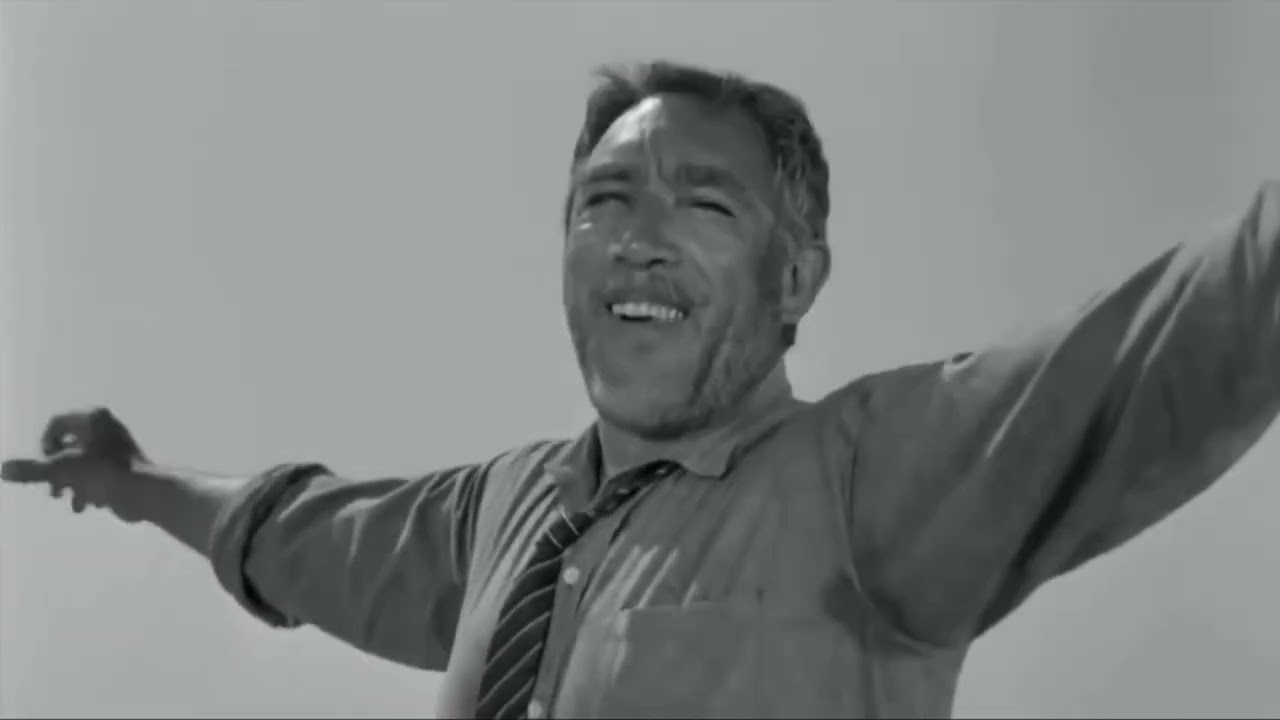
Anyhow, I was thinking more about the treatment of the widow, which is the most explicitly brutal part of the book—where the book really is pressured to display its moral chops and where it spectacularly veers away from this implied responsibility into some quite dark territory. It’s under this spotlight that the romanticization of the Zorba / Narrator relationship both in the book and as popularized in the movie version (particularly its final “teach me to dance” scene) becomes morally perverse to say the least.

At the risk of sounding hyperbolic, the way I interpret the dance scene is that Zorba and the narrator dance on the widow’s grave (taking the widow as the ultimate symbol of exclusion from the falsely universalised principles the two main characters represent). And there are two artistic hypotheticals that would make this point searingly obvious and immeditely flip the works pseudo-spiritual claims to an uber-morality on their head.

  1. (The more direct and possibly vulgar approach) Simply film the penultimate dance scene in cuts away from a static shot of the beheaded widow’s head.
  2. Write a short story from the widow’s perspective granting her the subjectivity the story denies her. Granting her her own claim to moral introspection and discovery. Show how this is incompatible with the ghoulish narcissism of the Zorba / Narrator pair.

The simple point is that in being fully exhausted as symbolic object, swallowed in the narrator’s conceptual scheme with no escape, not even a gesture to the dignity of her own personhood, the widow is denied her place as Buber’s “thou”. The dance at the end sanctifies the mutual affirming “thou” of the male protagonists in a dually exclusive way—that of the universalizing of a patriarchal dichotomy, which allows for no female “thou” in its structure and more deeply, that of a pact of a particular male friendship, that every character in the book simply served before falling away.

There’s much more to be said. For example, on the project as art. It has to be admitted, I think, that the book has artistic merit on some level. But there’s a resource in Zizek’s analysis of the spiritual and artistic to show that this is not incompatible with violence and exclusion. He gives many examples to show that Adorno’s phrase “to write poetry after Aushcwitz is barbarism” doesn’t imply that barbarism and poetry (art) are incompatible. In fact, under a Schillerian analysis, the narrator’s position is exactly intellectually driven barbarism, and Zorba’s position is the counterpart in savagery. Schiller’s unification of these formal and sensuous impulses also routes through art, but Zorba the Greek as art, while seeming to follow the same path at the level of authorial intention ends up somewhere much more disturbing.

So, I think I was too reticent and charitable to Kazantzakis in the previous post. His preface to the book, which I later discovered, shows he is right behind Zorba as spiritual guide, and therefore behind the novel’s explicit morally exclusionary messaging.

EDIT: I realize I ought to come back and clarify the historicity angle more in light of your comments, but I did want to add the above as my position on the novel has developed, and my historicity comments are based on only on the introduction to ND so far, so I need to read further.

1 Like

In The Last Temptation of Christ, K has the devil tell Jesus that there is only one woman in the world. One woman with many faces.

It’s complex because the Devil is explaining why it’s ok to commit adultery, Jesus defended an adulteress who was about to be stoned, and the widow in Zorba is ‘stoned’ with no one to successfully defend her.

In all of this, Woman is an almost overwhelming archetypal entity, looming huge in a dreamlike psychic landscape that impinges on the mundane.

For K, Jesus was burdened by the temptation to lead a normal life every step of the way, and the symbol of that is this archetypal Woman.

I think K is projecting his own struggle onto Jesus, and he did the same thing in his book about St. Francis.

Is the non-identical, living breathing woman eclipsed entirely by this psychic storm? I think that depends on the reader. It could draw your attention to that her, whoever she is, close at hand, human, for all that means, just like you.

And that’s also complex because K’s grand Woman is actually part of him. She’s not out there. She’s a part of him that is suffering.

I’m missing the difference here. How can a work of art be expected to recognize, much less address, that which is ‘violently exclusionary’, if that work is historically conditioned to understand its world in the very terms which exclude the possibility of identifying contradictions as contradictions, and exclusions as exclusions? Wouldn’t this require a view external to history? And doesn’t Adorno’s position doom all art except art which emerges from within his own preferred worldview to the status of bad, ideologically contaminated art?

Obviously—to me anyway—because historical conditioning isn’t totalizing. Not every artist in 1946 had to violently exclude women from their universalized ideal; culture doesn’t develop in one straight line that every member of the culture has to adhere to absolutely. I’m not positing causal necessity or arbitrary contingency: It’s not that the book is [had to be] sexist because the times were sexist nor that the book is [accidentally] sexist because the times were sexist, and so it could be. But it is that the historically conditioned context allowed such a book to be seen as great art because its ideal universe had something solid to rest on culturally. The culture provided the container into which it could be comfortably fit (and this container is also contained in the artist, as the subject and social mutually produce, mediate, and condition each other, but, again, not in a totalizing manner).

So, no, it doesn’t require a view external to history at all. In fact, a world in which there was only one precise ideal that synchronically everyone, including artists, just blindly reproduced, is so bizarre I don’t know how anyone could mistake it for this one.

And I don’t think Adorno’s position can be reduced the way you’ve stated it either. He posits a kind of horizon of reconciliation as a theoretical possibility but a practical limit and doesn’t claim that his favoured art is the measure that instantiates that limit but would admit that it fails too, but maybe fails better.

And, by the way, you may have noticed this discussion is complementary to the Deleuze thread, only without the complementarily vulgar title. Which would have been to take things too far.

To quickly add to what @Baden just said…

For Adorno, there is no art that isn’t ideologically contaminated, and he is not interested in an artist’s worldview. What matters is form: does it let the contamination show through? Does it result in a kind of autonomy, a divergence from ideology even while remaining embedded within it? Does it fail better?

EDIT: Incidentally, a better criticism of Adorno is that he tends to judge art according to whether it emerges from his own preferred tradition of European high modernism.

1 Like

It’s hard to comment on this because I haven’t read or seen the Last Temptation and I haven’t had time to look up timelines to investigate if K’s position developed. If you can fill me in on any of that, pelase do.

Zorba was written during WW2, when Greece was torn to shreds. The Last Temptation was written not long before his death. If you come across a biography of K, get it. He was led a fascinating life.

1 Like

I have essentially done this below. Although one ought to watch the whole movie in my view with this one change to properly destabilise the affect (and I do mean “affect” as in the intended emotional state) the penultimate scene is supposed to illicit in line with the exclusionary spiritual universe K wants to create. By contrast, the shot of the widow (a still from earlier in the movie when she is being beheaded) portrays the bone as per Zizek’s Lacanian twist on Hegel “The spirit is the bone”.

1 Like

Yes, I’ve taken a look at that later section and it seems Adorno is more critiquing the absorption of particular historical contingencies, real material conditions, into, as you pointed out, a constituent of being, in a way that removes real history from the possbility of critique. So, the link to what K is doing is strained there compared to my earlier references.

Thankfully, I’ve shifted mental gears over the course of the day to a more Zizekian angle as per the last post, which offers another way to approach this that is less ambiguous.

I imagine a Heideggerian response would run along the lines that real material conditions dont simply impose themselves externally onto a subject, but arise out of the interplay of interpersonal activities of individuals in the world. Our immersion in these patterns define for us the criteria of contradiction, exclusion, ethical correctness and critique. They therefore constrain and limit the kinds of discernment that Adorno sees to assume to be somehow outside the reach of these historical patterns which bind all of us.

I don’t know if it’s related, but I couldn’t finish his book on St Francis because it made me want to stick a fork in my eye. K can be very annoying.

Would Heidegger say there was nothing to the past but myth? Seems like a recipe for disaster.

I am somewhat sympathetic to that view, but Adorno would probably still claim that Heidegger’s ontological absorption of historical particulars consumes history’s epistemological openness. Something like the particular contingencies become closed off from critical reflection because they become essentialized into our identity, our existential weight.

But I don’t want to leave the actual book / film behind here. I wonder how you see the ideological universe being portrayed? How would you analyze it?

I can relate. The more I’ve looked at how the book / movie functions over the last few days, the more annoyed I’ve become, particularly on discovering K considered Zorba a true spiritual guide—that there is no internal tension there at all as far as he’s concerned. This is part of the reason I widened the theoretical lens, first to Buber’s I and thou, which provides maybe the clearest phislophical counterpoint. But then, in getting more nuanced, to Zizek / Lacan.

So, it’s not just that the widow (and women in general) are “its” rather than “thous”, but that the widow can be seen to play a very specific theoretical function in grounding the whole Zorba universe. And the text very systematically assigns her this function, which is as I mentioned above the “bone” from “the spirit is a bone”.

And I might as well elabaorate on that a bit here.

So, the idea is that in order to sustain the life-affirming philosophy of the male characters in the book, something must be disavowed, not just left out but sytematically excluded. The widow character performs this role. She is never given an interior reality, only the passive function of an object around which the desires of those who are interiorized, rotate. And therefore she is described in terms fitting to their desire, i.e. predominantly physical. (In Lacanian terms she is the “objet a”).

After she has fulfilled her positive role in advancing Zorba’s philosophy in the narrator, she is discarded; and, in fact, beheaded—the physical site we most associate with an interior role is literally removed, mirroring the earlier and analagous narrative removal of her interiority.

As if that weren’t enough, her death serves not as a lasting trauma for the narrator, but only a means for him to further cement his friendship with Zorba (the narrative device employed here is him reconciling the widow’s first attacker with Zorba and the three of them feasting together).

So the progress is from. 1. Narratively denied an interior world 2. Literally denied her own head. 3. Narratively denied any further affective force. She just disappears, and, of course, “she”, as in a recognizable person, was never there at all. The denial of her personhood, as illustrative of the denial of personhood to women in general, is just what the book / movie is about viewed from another perspective (Zizek’s parallax view). It’s the complement of the closed signifying chain of the ideological circuit (the spirit) the woman as person (the bone) is not admitted to.

And she plays the role of the objet a / the bone first symbolically and then more literally as a severed head. Hence, why explicitly “bringing her back” in her brutalised form in the clip destabilises the circuit—because it helps foil the denial.

Of course, under this theoretical vantage point, all signifying chains are incomplete. It’s a structural issue. But this is a particularly egregious exclusion, particularly disturbing given the book’s romanticization through the film. K could certainly have failed better.

Imagine that the Woman is a symbol of normal, homebound life. The narrator and Zorba did try to save her, with words and with physical violence, they tried.

What was happening around K as he wrote this, was this:

The country suffered catastrophic infrastructural ruin, a man-made famine killing roughly 300,000 civilians, a profound Holocaust wiping out over 80% of its Jewish population, and an active underground resistance movement before being liberated in late 1944. --wikipedia

And after liberation, Greece fell into civil war. If The Woman is a symbol of normal life, she was torn to shreds by the world K lived in. Zorba’s dancing is the spiritual message that though there may be grand purposes and blood gore all around you, you can just dance on the side of a hill if you want to. It’s definitely a lone, fool on the hill sort of message.

In a way, it’s a Buddhist message: let it go. Lay the burden down. Tune into where you are now, here. You can’t change the past, and even if you become a non-communist leftist as K did, you can’t fix the world. Let it be what it is.

But while you’re dancing on the hill, what about the world you’ve let go of? She returns in the Last Temptation, when Jesus is in the desert, she says, “Jesus, save me.”

I agree she’s lacking interiority. I think that’s because she’s a grand symbol. The fact that women have suffered from being reduced to a symbol does make the whole thing difficult to accept. I get what you’re saying.

Heidegger says our past comes from our future, in the sense that we always interpret the past in relation to where we are headed.