What Counts as AI-Generated Content on TPF

I think that was more a failure to recognize the process of photography. How the choices of composition, light and subject matter is the product of a thinking individual mind. A representation of how the photographer sees the world, rather than a literal representation of reality.

And I think it’s key that there’s this clear pathway between the intention of the artist and the result of creation. Another argument against AI “artists” in that the intention of the generation is rather in the hands of the algorithmic system rather than from the intention of the “artist”. It doesn’t matter how detailed the prompt is, there is always going to be empty space between the intention of the “artist” and the intention of the machine.

And that would lead some to argue that therefor the AI could be the artist if it has that intention, but then it lacks direction as it would never create something without a prompt. It becomes this unsolvable separation between the input and output. The formation of the result are unable to detach from that reality and form a synthesis between the two.

If the intention there is to mimic someone good at singing, then yeah, it falls under similar criticism as criticizing generative AI outputs.

And I don’t think those appreciating music as art would argue against criticizing editorial changes to simulate a good singing voice rather than having someone who can actually sing.

It starts to fall under the idea of content vs art. If the end result is to just reach a simulation of aesthetics to create a result for the purpose of just be part of an endless tirade of what can be called music, for the dance floor where people don’t care about the music, only the vibe, then it becomes the same as what I described of which types of people who will listen to AI music. The ones who don’t care about art, but the vibe.

It’s not about hearing the difference. It’s the same argument as with the sculpted statue. If I hear something that sounds good and then I am informed it’s AI generated, then I feel robbed of the connection to the human who would have poured their soul into that music. I don’t go into nature to appreciate art, I could enjoy the vibes, but a waterfall and rock formation is not the same as going into an art gallery viewing a painting.

The human connection is the fact that a human has made decisions creating the track, based on their individual life and experiences. Even when using synthesizers and other techniques, it becomes like photography being art through the perception of the photographer driving the intention, rather than a machine simulating based on a sum of previous creations.

An AI generated music track can have a good vibe and be musically perfect, but it is empty compared to a human made track with flaws carrying meaning.

Well, I would argue against it, though of course it depends on what you mean by a good (enough) singing voice. I’m all in favor of fixing pitch and phrasing problems in post-production. Though that, to me, isn’t really a matter of turning someone who “can’t actually sing” into someone who can, so maybe you’re OK with that.

I think you might be unaware of the omnipresence of editing when it comes to recording popular music. For that matter, it’s not uncommon in classical and jazz recordings these days as well, though that raises different questions. Basically, it’s a question of who’s being deceived, what the audience expectation is. Many classical fans want the recorded performances they hear to be “live in the studio,” just as if there were an audience present in real time. Many jazz fans feel the same way. So to present a recording that’s edited, without saying so, could feel like a deception to those fans.

With pop music, I believe strongly that there’s no deception involved, because for at least 60 years the artists and producers have been completely up-front about what they’re doing. Greg Milner’s Perfecting Sound Forever is an excellent account of the gradual change from “recording as capturing a live event” to “recording as creating a perfect artifact.”

Here’s the example I often give: Art Garfunkel’s vocal on “Bridge Over Troubled Water” is a huge popular favorite, and widely considered a masterpiece of pop singing. And so it is. But the finished recording is a stitching together of multiple vocal takes, done months apart in different studios. To say nothing of all the standard repertoire of reverb, delay, compression et al. that’s used to produce a vocal track.

So . . . learning this, are you disappointed? Do you think Garfunkel cheated, intending to deceive you? My suggestion is that, if you do feel this way, it shows that you haven’t understood the intentions (which you rightly point to as important) of what pop artists do. The creative personnel involved in “Bridge” were not interested in showing what Garfunkel could do as a live performer, in a way that would call for admiration of his skills and stamina. Rather, their intention was to make a perfect recording, by whatever means necessary. And all this was quite well known, then and now, because pop music had begun to make the transition I referred to above. Garfunkel was fine with it, as far as I know, and God knows the results were worth it. But mainly: No one was cheated or deceived, unless they didn’t know much about how records get made.

But if you can’t hear the difference, how can it be musically relevant?

This, perhaps, would be your reply. My response is the same as before: How you feel is not the ultimate criterion. Feelings change as knowledge and sophistication grow. At the moment, I agree with you – I haven’t heard any AI-generated music that can move me the way direct human expression can. Expressivity is a very important musical value for me. But not the only one. And let’s not be too sure about what Maestro AI may be capable of eventually.

Two things: Is “empty” something you can hear, or is it a theoretical conclusion based on what you think is required for good art? Also, you’re quite right that flaws can actually improve a work, but we’re no longer talking about differences you can’t hear. It makes perfect sense to say, “I like this piece better because it’s a little rough, and doesn’t sound too cookie-cutter.” But that’s an audible difference. You could make it about two pieces regardless of what you did or didn’t know about how they were created.

1 Like

In the spirit of philosophical questioning and social advocacy for those who might not be able to properly communicate for themselves, have we considered the possibility of individuals that might otherwise have intelligent thoughts and speak English but have significant impairment in communication due to mental disabilities or neurodivergence such as but not limited to cases of severe anxiety or severe ADHD whereby LLMs can serve as a reliable prosthesis, much like that of an AAC device is used for nonverbal individuals but for more complex conversational applications, to organize and clarify the original thoughts they cannot otherwise do on their own.

I understand that this rule is intended to prevent abuse and spam of slop content but do you think much like how we provide limited exceptions for non native English speakers, perhaps we should provide specific exceptions for individuals who have a legitimate need for communication assistance despite speaking English and being intelligent enough to understand and formulate unique thought but the inability to cleanly articulate or organize those thoughts without additional aid.

For example if we are going by the idea that the presentation changes what is expressed but the way an individual presents it on their own does not satisfy what they intended to say but after workshopping it using an LLM they produce a result that perfectly aligns with their intended interpretation and meaning wouldn’t that LLM modified message be more true to their actual thought if they themselves felt a stronger resonance with it?

How would this then be much different from sitting with a human aid who takes the time to help the individual translate their thoughts into coherent speech until they find such a presentation that satisfies their intended message?

Perhaps a way to accommodate this might be to allow LLM’s for the purpose of refining and organizing an idea but then one must reinterpret the output into their own words for the final product in the case of using it as an organizational aid or if used as a communication aid they must freely disclose their use of LLM and why they’ve used it along with their endorsement that the message is in fact faithful to what they’ve intended to convey and this specific part of the message cannot be written by an LLM.

Im sure there’s other ways to provide inclusive accommodations to such individuals so they too can participate meaningfully in such discussions but this is a topic of conversation around LLM’s I rarely hear get brought up and it’s something I think should be discussed more often.

1 Like

An interesting point. Perhaps just as there is a “TPF Supporter” flair there should be an “Intellectually Impaired” flair for those who are disabled, who can prove such with government documentation, who wish to articulate their right to free speech and participation in society.

I am sure this would not only be allowed but encouraged. Of course, to a limit. There is a such thing as “undue burden” in Western law.

No. Just no. There should be no such labelling or public declaration of disability. Any needs could be privately disclosed with Jamal when applying for membership.

Welcome @Philosophiliac. Thanks for thoughtful highlighting of this topic.

I found this: LLM models for autistic and neurodivergent individuals

The emergence of large language models (LLMs) like ChatGPT has transformed access to information, offering immediate responses to diverse queries. While these technologies present significant opportunities, they also pose unique challenges for the autistic and wider neurodivergent community. This commentary critically examines the implications of LLMs within this community, focusing on potential misinformation, reinforcement of stigmatising medical models, misrepresentation of non-speaking neurodivergent individuals, and issues of equity and privacy.

1 Like

Well, in that would be the case, in spite of your kind-hearted intention, that would only result in disabled people being unable to participate due to basically almost any thought or expression they have to express being consistently marked as “low quality” and otherwise endlessly and brutally scrutinized by the intellects here who, in pursuit of truth and logic, engage in what might be called merciless and pugilistic debate. That wouldn’t be fair to them. Nor to those who, upon realizing the state of mind of such a target, find themselves reeling in regret.

I feel at this point we’re discussing an extremely unlikely (though possible) case scenario. Once in a blue moon, a horse of a different color, a unicorn stumbling upon the tavern, etc. So, to get back to the point made:

Well, let’s ask a simple question. Do you enjoy a puzzle you cannot complete? Do you pursue something that frustrates you (if another party or entity did not put you up to it)? No, right? My point is, I don’t think the new poster’s (welcome BTW!) point has much relevance or actual application as far as events that might occur.

Perhaps there should be a WARNING sign in the Welcome page for EVERYONE!
'All ye who enter here, abandon all hope of tolerance by brutal intellectuals!’

Oh, be fair. :slightly_smiling_face:

We entered into a rare case scenario where emotions naturally run high. Generally speaking, the average person should appreciate (if not even be enticed) by such an environment.

I was merely suggesting the new poster’s argument is a rare case scenario that doesn’t apply to 99% of posters and so isn’t something worthy of a major policy change that affects the 99%. That’s all. No fuss. :sweat_smile:

Thanks for the find I am looking forward to reading it more in depth but from what I have seen so far I can’t say I disagree with the opening statement of that article. Indeed there are pros and cons to the use of LLM’s for neurodivergent individuals but I suspect that in a large part depends on how it’s utilized and if that utilization is appropriate.

For example as I briefly touched on I suggested that the individual where they can may refine an idea with an LLM but then paraphrase it into their own words using the rough outline of the argument to aid them in the construction

Or if the issue is one of articulation rather than structure they can review and scrutinize the LLM output until it aligns exactly with their intended message and then provide a proper endorsement that the message though produced with the help of an LLM does in fact hold true to the message they hope to convey. (I also agree that it could be problematic to force people to openly label and identify themselves potentially making them vulnerable to bad actors however perhaps there is a middle ground where we can just add a flair for something that signifies an approved use of LLMs within reason that could act as a catch all flair for both individuals with disabilities or non native speakers or any other potential outstanding reason that the moderators might approve, this maintains a level of ambiguity while still providing the necessary express permission)

These two methods where possible I think should resolve most of the issues of neurodivergent individuals being misunderstood as a result of LLMs whereas the misunderstanding issue is more likely to arise when individuals simply put the full burden on the LLM to fabricate the totality of an idea itself or just copy and paste whatever it spits out without proof reading it to confirm it aligns with their actual intended meaning.

Like I said I have just read the beginning of the article thus far so they may cover this further down but I mainly wanted to express my appreciation for you sharing this before I continue reading.

(Also to note my previous deleted comment is identical to this one however I thought it hadn’t replied properly so I tried deleting and reposting it.)

1 Like

Thank you for bringing up an interesting issue. The upshot is that I think we should (a) make it clear that messy or rough drafts are ok, especially for people with the kind of impairments you’re talking about; and (b) encourage such people to get in touch privately so we can deal with things case-by-case and possibly make exceptions where appropriate.

Not really. Or rather, not only those things. My main concern is to maintain a community in which discussion happens between people (not between LLMs) expressing themselves in their diverse ways.

The reasoning behind the policy is given in the announcement above, i.e., in the OP.

This is explicitly allowed already. However…

I don’t think this will work. It is unenforceable, and I don’t accept the model of expression it’s based on: in short, I do not trust anyone’s endorsement that an AI output is faithful to their intentions, if that is even a coherent way of putting it.

I am glad to hear of this beneficial outcome. Appreciate the care involved in listening and responding to concerns.

Some ‘messiness’ can be accommodated when writing posts; it shows the workings of an unclear mind. This is the thinking process. It is OK not to be perfect. Further questions and discussion result, if people are interested.

Your concern is understandable, but perhaps there is too much fear of slippery slopeiness.

AI is here to stay. What is needed is to impart clear knowledge: how to use it as a tool, in an intelligent and questioning manner.
This, to help achieve your aims in helping people ‘express’ in ‘diverse ways’.

Staying with aspects of expression, use of AI and its fit of faithfulness to someone’s ideas.

‘Expression’ can be a concept or an activity. Exploring Expression: A Philosophical and Aesthetic Overview

I think it is possible for a person to say that AI has helped them reach their aim to express themselves and their thoughts.

The implications of this are significant. To write or express is to think — to grow and develop imagination and creativity.

In life, it can help improve self awareness and attend to other perspectives.

In TPF, it can be a way to appreciate the voice of a diverse and tolerant community.

Edit to add: even if AI changed someone’s ideas, what is wrong with that?

I’m not disappointed because I already knew this. The difference is still that there was an intention by individuals as to what they were doing. It’s the same as how David Fincher does hundreds of takes of someone walking through a doorway and then stitching together different takes with visual effects in order to get the perfection of that specific character walking through the doorway.

Neither of this negates the point I made. That the intention comes from the individual artists, not from something that detach that from the request. If the request, either comissioned or by the urge of the public, is to make music or a film, and the intentions of the artist becomes to make something “perfect”, they still are the deciders of what it means to make something “perfect”. It becomes their definition. Some view Fincher’s movies as too clinical and perfect to them is a messy camera move thet bumps into the set.

Though in comparison, the use of song modulators and even modern AI modulators which take someone’s song and rewire the waveform to fit some standardized curve programmed by a committee of people deciding what constitutes “perfect” by programming the tools for the purpose, that’s a bit different and closer to the end goal of replacing the performer entirely with a voice that do not exist. And this then becomes more of an aesthetic philosophical discussion more than about AI.

The point being is that gen AI is just the end point of removing the human from the production of anything. The more you remove human involvement, intention and decision making, the less meaning people feel about it.

Aesthetic appreciation is not appreciation of art. I can appreciate the waterfall and natural rock formation, just as I can view a generated AI picture and find something interesting in it, but in art, the subtext of the human creator, the thing beneath the piece, is an important factor, even if it is unclear what the intention was.

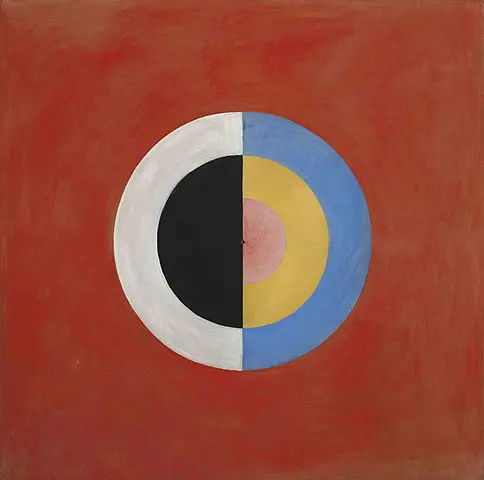
It’s the difference between AI producing abstract art, generating it from some median of the most likely formation that would be defined by the genre, and a painting like this, from an individual mind.

If you appreciate art, you are not merely appreciating the shapes, colors and composition, you are feeling a very abstract connection to the artist. You don’t know the intention, you don’t know why any of the choices in making it, but it’s a deeply human connection, a non-verbal, non-information communication of one mind into your own. It doesn’t matter what time and space is between you and the artist, but you glimpse a thing that is deeply human in how we relate to one another.

If this was made with an AI, all of that disappears. You just get the image and you can appreciate the image as an image, but it’s not nearly the same as if it is painted for real.

This context matters, and it’s why so many people hate gen AI today, even without understanding why they hate it. They feel it lacks something, just like they feel in a room that was architecturally designed by a committee of politicians, those dead spaces which constitutes much of the liminal horror today. Spaces designed for a purpose but not for people to feel anything. Like a waiting room in a hospital, a buss stop, an elevator. They’re just there, without a true connection to our sense of being human.

The knowledge that someone had a clear intention and made careful decisions as to achieve that intention that directly links to the outcome, is what creates this abstract bridge between the artist and the receiver. Gen AI cannot achieve this and it’s why as soon as someone realize something was generated by an AI, they feel it loses something important, even if the appreciation of the image remains.

It loses a soul, while the body remains.

It’s this that is the misunderstanding of the fact that art is not content. As defined in the above answer.

We appreciate living people more than corpses.

AI is here to stay, not to demand a specific use.

I don’t know why it is unclear in how it is supposed to be used on this forum.

  • You can use it for research, but you cannot quote it as hallucination rates are high and it is unknown at what level the poster understands how to use an LLM effectively for factual outputs in research.
  • You cannot use it to generate your answers and simply copy/paste it into a discussion. This becomes the LLMs debating other LLMs that @Jamal warns about.
  • Everything posted on this forum needs to be written by yourself.
  • If you aren’t versed well in english and need to translate into english, this can be fine as long as you use the built-in translator of the forum (right, @Jamal ?), and you can also use your own LLM to translate someone else’s post into your language, but only for reading and be able to reply, not to generate answers to it.
  • If quoting an AI generation, there has to be a specific reason for it that has a purpose for the discussion. Like, if the discussion is about AI. And it needs to be clearly marked that it is AI generated. HOWEVER, some posters have made it into practice to just spam threads with stuff like “here’s what chatGPT thinks about this” and then pages after pages of long generated blocks of text. This is not the same as occasional quotes.

I don’t think there has to be discussions about the rules for this. @Jamal and many others are well informed about how LLMs and AI work and the rules reflect this understanding.

I’ve done a lot of studying on the subject and used AIs a lot to get into proper understanding of them. But I’m not someone who resides into a capitulation that “AI is here to stay” so therefor everyone must just act according to the tech oligarch’s world views.

If people don’t understand how these AI systems work, they are easily fooled by the public narrative of their brilliance. But there’s a limit to what they can do and there are consequences people simply aren’t well versed in understanding.

Because it reduces the understanding of ideas into a conformity based on the neutral ground and values it was programmed to curate. People seem to not understand that the weights and biases that the system uses have been curated to reflect a certain world view and ideology. And it is unable to do anything but reflect upon old knowledge, in which new ideas can never be analyzed as novel, only whether they are verified by previously defined concepts and ideas.

AIs cannot create anything new, even if they synthesize two things that haven’t been before, it does so without an understanding of why or how.

So if someone gets their ideas changed, it’s not through the interaction with another individual’s thoughts, or group of individuals, it’s by a system that produces a median of understanding based on only old ideas. It rejects everything new by that comparison.

It simply changes someone’s ideas into conformity and mindless analysis.

Simply put, AI can sift through information, it can summarize, it can translate, it can spot statistical signifiers. But it cannot produce or generate anything in a helpful manner if prompted to create something. Not in art and not in ideas. Believing that is to believe the tech corp marketing hype. It’s to believe the systems operate in ways they’re not.

And for this forum, just don’t generate stuff from an AI and post it. Simple as that. It’s not the place for it, it’s not the purpose of the forum to be a dump for LLM generated texts.

If the purpose is for people to come together and talk, then that’s what this place is for, not to be a posting wall for AI generated text.

Yes, I’m pretty much in agreement with everything you say about the role of intentions in crafting music and music recordings. I wasn’t sure if you did see it that way, because of your comments about editing a singer’s performance.

But I think we both realize that there’s an endpoint, which may now be within reach thanks to AI, where there’s no direct human involvement whatsoever, and that’s problematic. What Beato talks about in that video I linked is the very thing you’re discussing – What happens when a listener learns that there is no connection between what they thought they were hearing and a real human? Is this more than a matter of deception, of not being offered “truth in packaging”? Is there something about a work of art that is not a human communication which renders it defective, even when you know its origin story perfectly well?

That said, I would urge you again to stay more open-minded about how art works. I totally agree that appreciating art as a connection with another human mind or soul is one important way of interacting with art. But it isn’t the only way, nor is it definitional of what art has to do. I’m not sure who “they” are, the ones who feel the lack you describe, but I wonder if you aren’t projecting your and their dislike and claiming everyone feels that way. No offense, I hope.

The OP applies mainly to posts consisting of text presented as written by the user. What it doesn’t explicitly address is the use of LLM-generated text in quotation blocks and attributed to the LLM.

It came up earlier, and I clarified the policy:

Since then, two people have expressed the view that we ought to make an exception for such so-called quotations. I’ll address @WeSee’s objection first:

The claim is that quoting a human author and copying LLM output are equivalent, on the grounds that neither represents the poster’s own voice. There are a few problems with this view.

First, the two cases are very different. When you quote Kant, you are referring others to the thoughts of a specific mind that produced those thoughts at a specific moment in history, for specific reasons, within a context of intellectual history that can be traced, examined, and engaged with. None of that is true of quoted LLM output, because it was generated on demand by the user—there is no authorial position behind it.

Second, the claim that neither represents the user’s voice is a misleading way of describing the situation. Quoting an author, in the context of philosophy, is part of the act of expression. It involves selection and contextualization, with a view to integrating the quotation into what the user is saying. The quotation is independent and subordinate—the user brings it in from outside to serve a point they’re making independently of the author quoted.

Using LLM output in the guise of a quotation does not work that way. The text does not exist independently. Rather, it is generated in response to a prompt that has what the user wants to say already baked into it. The user doesn’t do anything comparable to the selection that goes on when quoting an author, so what appears as an act of quotation is not one at all.

Third, quoting an author “as a source of additional information,” though it might sometimes happen, is hardly the most common use of quotations in philosophical discussion. They are more often used to present and examine ideas, insights, and arguments.

Now, I’ll address the general objection, by way of @Banno’s comment:

We are not allowing quoted AI output, even when explicitly identified as such, because it would defeat the purpose of the policy: people would use quotation blocks to circumvent the rule against posting AI-generated text. And it is not equivalent to quoting an author, as I explained above.

More generally, the forum exists for human discussion. The aim here is not to build an archive of plausible, smooth, inoffensive prose, but to facilitate discussion between people attempting to think through problems, formulate positions, and respond to one another directly. Allowing AI-generated text in any form will detract from this aim.

NOTE 1: This applies equally to cases where AI output is used to present information or evidence. Scientific data, factual claims, and references can be included by citing the original sources directly.

NOTE 2: There might be limited exceptions. For example, using AI to help create the markup for a table and then using that in a post (e.g., “Claude, kindly make me a table of synthetic/analytic vs a priori/a posteriori for posting on TPF”). This kind of labour-saving AI work is fine, I think.

I will probably post another clarifying announcement on this specific issue, once the discussion has run its course.

EDIT: Actually, I’ll probably just update the OP.

2 Likes

Read this:

It explains how the use of online asynchronous discussion boards as a course requirement has been destroyed by AI. The concerns in the academic setting are mirrored in our forum.

The solution suggested in the article is to return to in person discussion groups, which identifies that the remote asynchronous learning systems might have been a temporary technological contrivance that has now become obsolete with new technology.

We have to remember that our sort of forum is relatively new and is also subject to obsolescence if we use it in a way unintended from its original purpose.

While clarification of the rules is necessary, I fear the issue isn’t confusion, but non-compliance, self-justified as somehow appropriate or even as defiance, based upon a realization that improper AI use cannot be accurately identified and removed.

The way we sustain will not be through the passage of more laws and a stronger police force, but by a commitment from every poster here to not only avoid misuse of AI, but to avoid even the appearance of it.

Every one of us can become online chess grandmasters, beating the world’s best, and we can argue there is great value in only making the best moves even when it means using all the online chess move making resources, but that’s not you playing chess.

This is my long winded way of saying, please play by our AI rules here. You’ll get it away with it if you try , so don’t try. There is a place for these boards onward, but only if we cooperate.

Press the blue button. :innocent:

4 Likes

What the hell does that mean?

It means if you are hell bent on using it, translate it into your own words well enough that I don’t even catch a hint of the scent of the AI you’ve been whoring with.

The above is an example. No one’s accusing AI of writing that.

I mean, it’s a fair point. Some of us are just awkward bookworm types who like to be meticulous or otherwise happen to have a very simple and direct point to make and do so with minimal expression or “personality” yet maintain a dull yet intelligent if not robotic conciseness. Just saying. :person_shrugging:

Not to push back on a decree I agree with, but it’s liable to produce a reasonable curiosity or even confusion in some. Staff seems to like discussions serious, to the point, not so much “casual and friendly” (certainly not profane, even lightheartedly and facetiously). No “locker room talk” or excessive emoticons and what not, lest we turn into Reddit. :sweat_smile:

Edit: For example, here is me "knowingly typing “like AI”:

While it is certainly not possible to detect all forms of AI usage, one can reasonably discern such using a combination of common sense, due diligence, and third-party tools which will facilitate the discovery of such.

Guarantee if you plug that in to a “AI checker” it will come up with a high rating despite it being literally something I typed out and a more or less (albeit forced) actual thought stream from mind to keyboard.