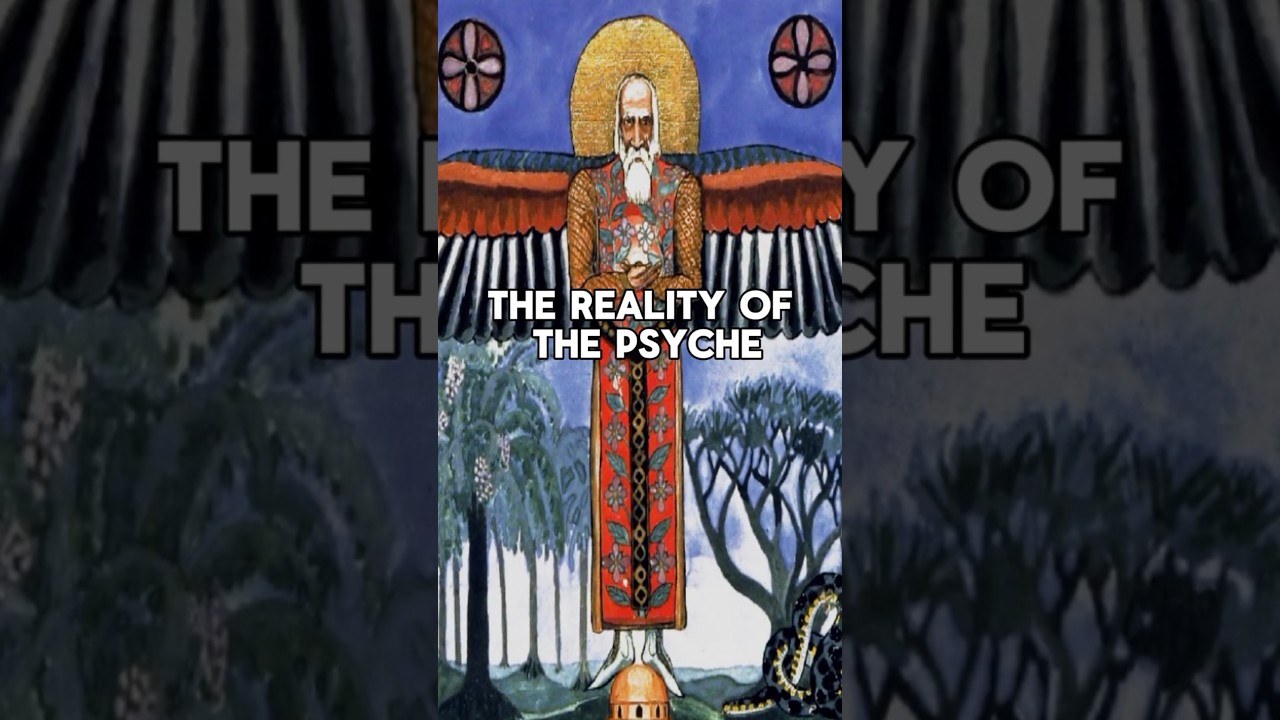
For a start, what is this “active unconscious”? Being “unconscious”, doesn’t that mean it’s “off”, in your view? Then the “subconscious”. What is that, and how does it differ from the “unconscious”, whether it be active or passive?
What???
***************************
I’m not being facetious here, or argumentative for the sake of it. I just can’t make any sense of what you’re proposing. Genuinely sorry.
Jung presented the difference between the conscious and the unconscious in an evolutionary context. Humans emerged through natural selection and what Jung calls psychic energy:
Childhood, therefore, is important not only because various warpings of instinct have their origin there, but because this is the time when, terrifying or encouraging, those far-seeing dreams and images appear before the soul of the child, shaping his whole destiny, as well as the retrospective intuitions which reach far beyond the range of childhood experience into the life of our ancestors. Thus in the child psyche the natural condition is already opposed by a “spiritual” one.
–On Psychic Energy section 98
For theoretical reasons as well there must be some tension of opposites in the child, otherwise no energy would be possible, for as Heraclitus has said, “war is the father of all things.” As I have remarked, this conflict can be understood as an opposition between the profoundly primitive nature of the newborn infant and his highly differentiated inheritance. The natural man is characterized by unmitigated instinctuality, by his being completely at the mercy of his instincts. The inheritance that opposes this condition consists of mnemonic deposits accruing from all the experience of his ancestors. People are inclined to view this hypothesis with skepticism, thinking that “inherited ideas” are meant. There is naturally no question of that. It is rather a question of inherited possibilities of ideas, “pathways” gradually traced through the cumulative experience of our ancestors.
–ibid. 99 section 99
To one familiar with our psychology, it may seem a waste of time to keep on the long-established difference between becoming conscious and the coming-to-be of the self (individuation). But again and again I note that the individual process is confused with the coming of the ego into consciousness and that the ego is in consequence identified with the self, which naturally produces a hopeless conceptual muddle. Individuation is then nothing but ego-centredness autoeroticism. But the self comprises infinitely more than the mere ego, as the symbolism has shown from of old. It is as much one’s self, and all other selves, as the ego. Individuation does not shut one out from the world, but gathers the world to oneself.
–On The Nature Of the Psyche, section 432
“Our findings show that the brain is far more active and capable during unconsciousness than previously thought,” said Dr. Sameer Sheth, professor and Cullen Foundation Endowed chair of neurosurgery and a McNair Scholar at Baylor. “Even when patients are fully anesthetized, their brains continue to analyze the world around them.”
The subliminal-persuasion debunking is correct, and it is also the less interesting half of the story. The inversion: the popular fear was that the unconscious is a backdoor that others can sneak messages through, and decades of research found that door mostly shut. But the unconscious is not a passive vault waiting for inputs. It is the active author of most of what we later report as decisions. The Libet-style result people resist is not that hidden advertisers control us; it is that “I decided” is often a press release issued after the fact. Lacan’s version is sharper still: the unconscious is not a hidden warehouse of instincts, it is structured like a language, and it speaks in slips and symptoms, in what fails to