As much as I like many worlds as a fictional concept, it always felt like it suffered from the same problem as string theory, as in, the addition of over 20 dimensions is required to make it work, and many worlds adds infinite variations of the universe for every single elemental particle difference in the entire universe.
It’s a can of worms of an interpretation that seems born out of a frustration rather than working out from the facts.
I always viewed it as the bulk universe (4th dimensional spatial function) of three dimensions of spatial directions and a fourth direction that in a higher dimensional viewpoint becomes a direction like every other… but that while the common idea about the bulk universe is that it extends into the future, I think it is rather just extending into the past, like a growing tree trunk, and that the present constitutes a reaction edge where the established, stable bulk comes into contact with the random probabilities of where it would logically grow, collapsing into the most stable probability and the bulk grows. As all interactions cause quantum random states to collapse, our observations of the event is that of the bulk when it connects to a random probable future path.
That we’re essentially experiencing reality at the edge between the bulk of a frozen past and the future of absolute randomness.
I still haven’t come across much that disputes or contradicts this hypothesis, even when I’m sure I’m wrong about it. It’s almost a frustration that it fits well into a lot of evidence and observation, yet I’m in no way a physicist and schooled to verify it, so
Newton’s laws of motu + Einstein’s E = mc^2\to Nuculear ICBM.
C’est la vie.
It’s not all bad. Nuclear power plants are said to be better environmentally. Newton’s first find was the shape of the orbits of comets. Comets, asteroids, dinosaurs …
I quite like intuitive explanations of science. I struggle with oddities like symmetries, string theory and Electron Spin but there are good popular science books.
I am hopeful that some of the as yet unknowns will be illuminated by larger colliders, studies of gravity waves, quantum computers AI and a new generation of matter detectors.
I am sceptical, however that the discoveries they will have significant consequences for the world of macro objects and the inhabitants of a planet a long way from a black hole boundary.
Of coutse I can’t say for sure that there will be no consequences for what I believe because we can’t know what we don’t yet know.
But I do therefore feel justified in continuing to modestly distinguish what is likely to be true and therefore useful and what is not.
If you want a respectable Philosopher who might agree with such a preposterous claim. It is William James.
Unfortunately, as much as I like her videos on ripping bad papers a new one, she often speaks outside of her field, and even when staying inside her field, to question any discovery or progress that helps build the body of knowledge for humanity is a rather odd statement. It’s like she expects physics to solve world hunger or something, rather than seeing the benefit of physics in itself; steps of better understanding our fundamental existence. That is in itself the positive part for humanity. And then I’m not even mentioning all the inventions which came out of previous discoveries and theories that had a similar “worthless” label before they gained worth later on.
Sabine often plays the YouTube algorithm for gaining views, she often oversteps in a lot of areas, especially in videos on AI… (while being sponsored by AI companies).
She should stick to reviewing papers and talking about physics, without playing the conflict-tuned algorithm of the attention economy.
Wikipedia has a page, unsolved problems in science. I tried reading it but these problems are at the frontiers of the field and are undecodable by the l’homme ordinaire.
There was a 2008 book published on Hugh Everett III, subject of The Many Worlds of Hugh Everett, Scientific American (sometimes has been paywalled, sometimes not.) It is not what you would call a flattering portrait. Everett was a math genius but a very difficult personality, a hard drinker, someone his own children barely knew. Left academia for a career in the military and is often thought to have been portrayed satirically in Dr Strangelove. Died at 51 an alcoholic leaving instructions for his ashes to be put out with the household trash.
The interesting question is, what problem is Everett’s proposal a solution for? I think it’s an attempt to deflate the philosophical implications of ‘the measurement problem’, specifically, why it is that the act of measurement should precipitate a definite result where previously there had only been statistical probabilities (the well-known ‘wave function collapse’). It’s not, as some will think, because the experimenter nudges or interferes with the objects of analysis in the act of measurement. It’s that the act of measurement or observation precipitates a definite outcome where previously there was only a range of possibilities (described by Ѱ). But the nature of ‘system’, ‘measurement’ and ‘observer’ are not defined in the equations! This is what John Stuart Bell referred to as the ‘shifty split’. And this is what has generated decades of controversy.
So Everett’s proposal is simply that this ‘collapse’ never happens. It does away with the whole problem and seeks to preserve the pure objectivity of the act of measurement. But to many observers, the cost far outweighs the benefits of the solution. Philip Ball has a great critique here. (Interesting that David Deutsch, one of the founders of quantum computing, is utterly convinced by MWI and tends to regard its doubters as the ones who are delusional.)
Oh— and I should say that Everett does proceed ‘on the basis of the facts’. But it’s what the facts mean that is central in this subject. Hence the controversies!
I wonder if this is going to evolve/devolve into an infinite scroll debate on said big mysteries rather than a comment on their current scientific irresovability.
And what I mean by that of course is cool, thanks.
Since the cat cannot be both dead and alive in the same world, the world splits into 2, one in which the cat is alive and one in which the world is dead.
I heard some physicists have adopted the MWI as a better alternative. Among other things it blocks woo-woo-fication of the science via observer-dependency (Copenhagen). It can’t be helped though. Bohr was given a title by the King of his country (forgot where he’s from) and he asked for a taijitu symbol on it. Do we ignore this or do we create a new folder?
If you think it through, not only does the Everett interpretation imply that the world ‘splits’ but that it splits into an infinite number of versions of itself, one version for each minute difference. It’s mathematically consistent but ontologically preposterous.
Whereas the Copenhagen Interpretation (so-called, that being the name that Heisenberg attributed to the ideas of himself, Bohr, et al in his 1955 book), for all its ambiguities, embodies a certain epistemic modesty: don’t claim to know what the theory gives us no grounds to know. The mistake is to suppose that because it declines to specify an underlying reality, it must be deficient, that we must be able to peek behind the curtain to see what is really really real.
The infinite scroll is the result of wheels spinning without any traction, to muddle my metaphors; and that happens when we leave out the maths and the experimental evidence - the favourite approach of the backyard philosopher.
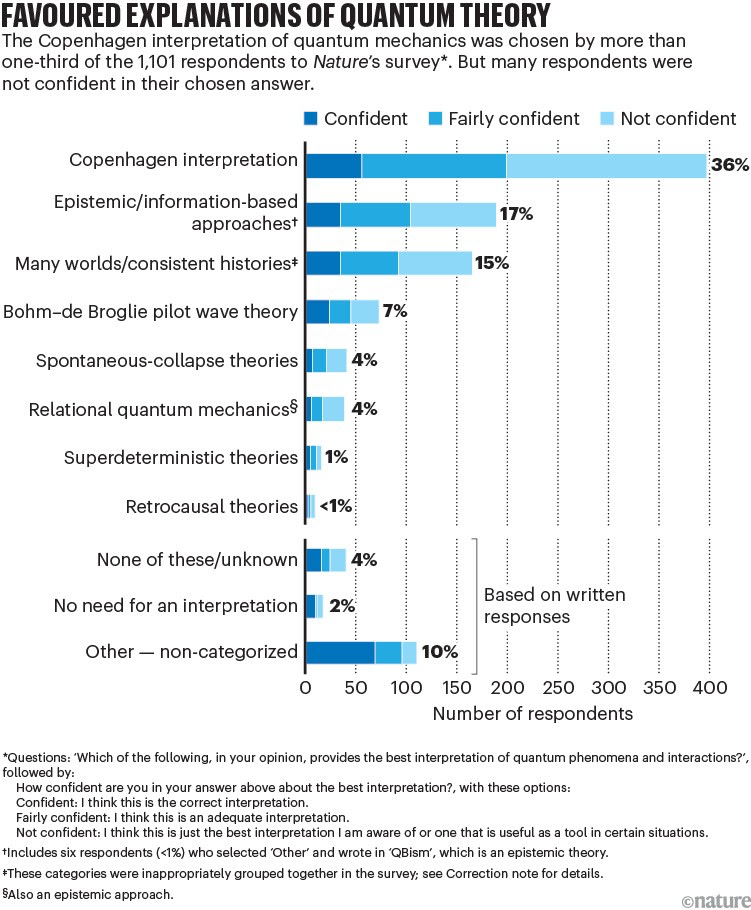
So you really want scientists to reach some agreement? Again, I admire the 17% who happily say “I don’t know”.
Physics, and other STEM areas, are probably facing or heading toward a major catastrophe. A physicist’s acme is to acquire a faculty position or make a discovery. Since the latter is a rare event, the former is every physicist’s dream. We end up with the physicists sole purpose being producing more physicists and these new ones doing the same thing ad infinitum.
I’m not denigrating anyone or anything but isn’t this a problem for so-called academia in general? I believe they’re already shutting down/downsizing philosophy departments.
A point may come when it would be not smart but foolish to be a physicist or some STEM professional. AI will probably hasten the inevitable fall.
The point about all these mysteries is that they’re inadjudicable. Expert opinion is divided and there’s no court of appeal. I notice @noAxioms will say ‘it depends on the interpretation’ when it comes to philosophy of physics. Which is basically ‘depends on who you ask.’
I think it’s possible to arrive at a philosophically coherent understanding without knowing the mathematics, to a point. But you always need to defer to those who genuinely know better.
Indeed, on both counts you’ve hit the mark. In fact this is exactly what quantum physicists dread because it leads to the woo-woo-fication of their field (pace Bohr, Heisenberg et al). The MWI has adherents as many as Copenhagen has.


 symbol on it. Do we ignore this or do we create a new folder?


 AI will probably hasten the inevitable fall.